Process layer for resource coordination during disruptions.
Sortium turns a crisis or civic team's scattered input into a living challenge graph, verified shared understanding, and clear paths to contribute.
Crisis networks don't lack the will to help.They lack coordination capacity.
Volunteers, resources and decisions live across chats, spreadsheets, meetings and personal networks. The intent is there. The structure is not.
Overloaded coordinators
A handful of people hold the whole picture — and become the bottleneck.
Duplicated work
Three teams call the same shelter. Two spreadsheets contradict each other.
Unclear ownership
Nobody knows whose task it actually is.
Slow volunteer activation
Capable people wait days before they're matched to something useful.
Weak follow-up
Tasks get handed off and quietly disappear into chat threads.
Invisible local capability
Skills and resources exist nearby but can't be seen or reached in time.
A living challenge graph, guided by conversation.
Think Palantir, but for civic coordination.
Two surfaces, one shared model of the situation. The graph holds what's known and who's involved; the guide helps each person find where they fit.
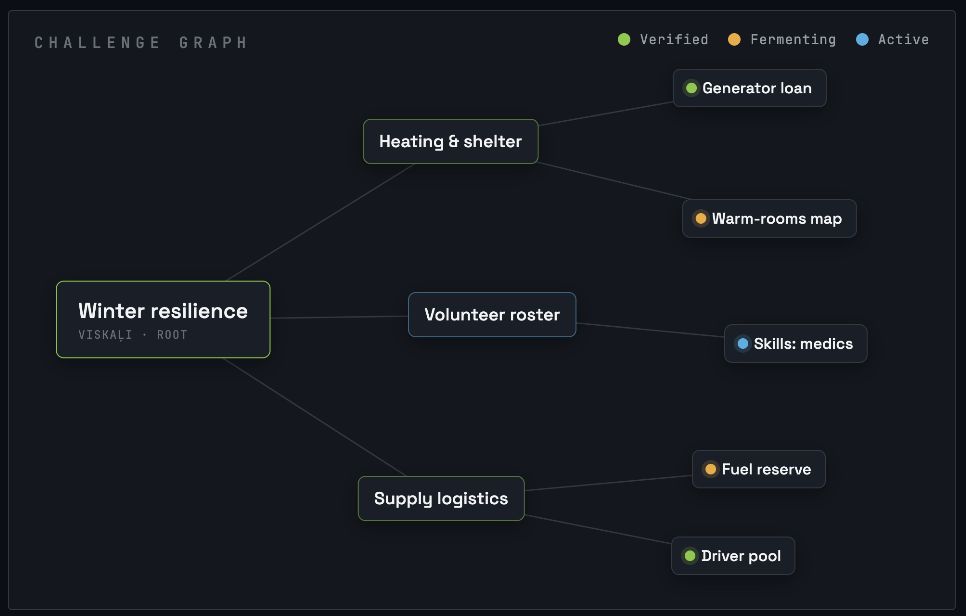
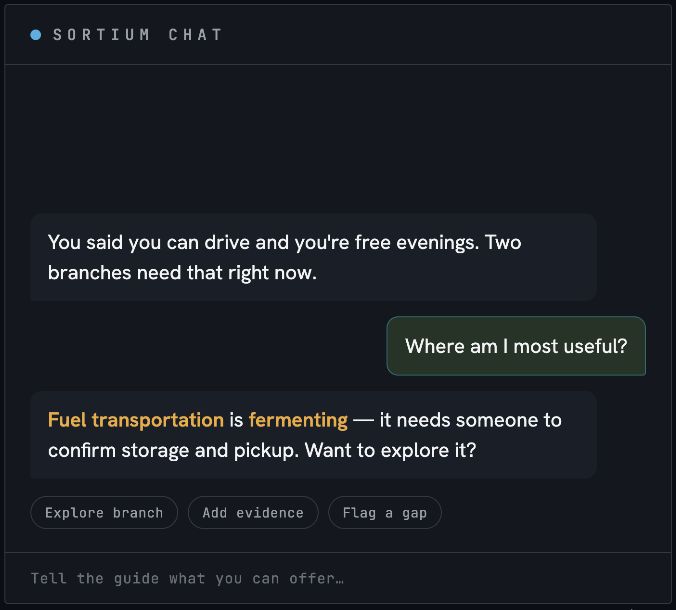
How one contributor moves through it.
The same loop runs for everyone — newcomer or coordinator — and the graph gets a little sharper each time someone passes through.
- 01Onboarding
Invite, orient & pick a vector
A new contributor joins. The guide explains the situation in plain language — no briefing call, no catch-up doc. They choose where competence and motivation actually fit, what they can give and what they care about.
Newcomers go from 'lost' to 'useful' in minutes. The right people opt into the right branches by themselves. - 02Contribution
Zoom in and contribute to nodes
Sortium opens the branch that needs them, with current state, who's involved, and the open questions still unresolved. They add support, criticism or evidence to a specific node in the challenge graph — not another scrolling chat thread.
No more re-reading three months of chat to get up to speed. Every input has a home; nothing gets lost in scrollback. - 03Synthesis
AI proposes, humans verify
The AI suggests merges, splits, re-priorities and surfaces gaps. New input ferments in the open before it becomes truth. A coordinator weighs support, criticism and evidence — then confirms or rejects before anything becomes permanent.
Decision support, not replacement. Verified once, still reversible if reality changes. - 04Loop
Understanding compounds
Shared understanding and coordination get sharper with every pass. The next person who arrives picks up where the last one left off.
The graph gets a little sharper each time someone moves through it.
Run one shared initiative end-to-end with us.
We start with NGO, civic, and community coordination — frequent, measurable, and lower-risk than formal emergency response. First pilots are exploratory and structured around your real work.
Talk to us about a pilot
Tell us about your network and the coordination problem you're trying to solve. We'll respond within 48 hours.